

















15 results for "JavaScript"
Articles (12)

AWS
AWS Lambda Explained: Serverless Compute, Functions, Triggers & Real-World Architecture
Learn AWS Lambda from the basics to real-world serverless architecture. Understand Lambda functions, triggers, event sources, execution roles, environment variables, layers, timeout, memory, concurrency, cold starts, API Gateway integration, S3 events, SQS processing, CloudWatch monitoring, error handling, and a practical hands-on Lambda lab using C# and JavaScript.

ReactJS
Code Splitting
Code splitting divides a large JavaScript bundle into smaller chunks so users do not have to download all application code before using the first screen. Route-based splitting is one of the most practical approaches.

ReactJS
XSS Prevention - Cross-Site Scripting
Cross-Site Scripting occurs when attacker-controlled content is interpreted as executable HTML or JavaScript in a user's browser. React escapes ordinary text rendering by default, but applications can reintroduce risk through unsafe HTML rendering, unsafe DOM APIs, third-party scripts, and insecure content handling.

ReactJS
CORS and CSRF
CORS and CSRF solve different problems. CORS controls whether browser JavaScript is allowed to read cross-origin responses. CSRF protects cookie-authenticated applications from unwanted state-changing requests initiated by an attacker-controlled site.

ReactJS
Promises, async/await & API Calls
React applications commonly communicate with backend APIs. To understand API calls in React, you need a solid understanding of JavaScript asynchronous programming, especially Promises and async/await.

ReactJS
Closures, Callbacks & Functions in React
Functions are everywhere in React. Event handlers, callbacks, array operations, effects, custom hooks, and component logic all depend on JavaScript functions.

ReactJS
JavaScript Higher-Order Functions — map, filter, reduce, forEach
Higher-order functions are one of the most important JavaScript concepts for React developers. React code frequently uses functions such as map(), filter(), and reduce() to transform and work with application data.

ReactJS
Rendering List and Keys
React applications frequently need to display collections of data. Examples include products, employees, orders, messages, notifications, and search results. React commonly renders these collections using JavaScript's map() method.

ReactJS
Conditional rendering
Conditional rendering means showing different UI depending on application data. React uses normal JavaScript conditions to decide what should be displayed.

ReactJS
Conditional Rendering
Real applications rarely display the same UI all the time. A screen may show a loading message while data is being fetched, an error when a request fails, an empty state when there are no records, or a list when data is available. React uses normal JavaScript expressions and control flow patterns to handle these situations.

ReactJS
What is JSX?
A React project is more than a collection of JavaScript files. A modern project normally contains source code, dependencies, build configuration, static assets, and an entry point that connects the React application to the browser.

ReactJS
What is React?
React is a JavaScript library for building user interfaces, especially applications where the screen changes frequently based on user actions and application state.
Cheatsheets (1)
eBooks (2)
Paid · $0.00
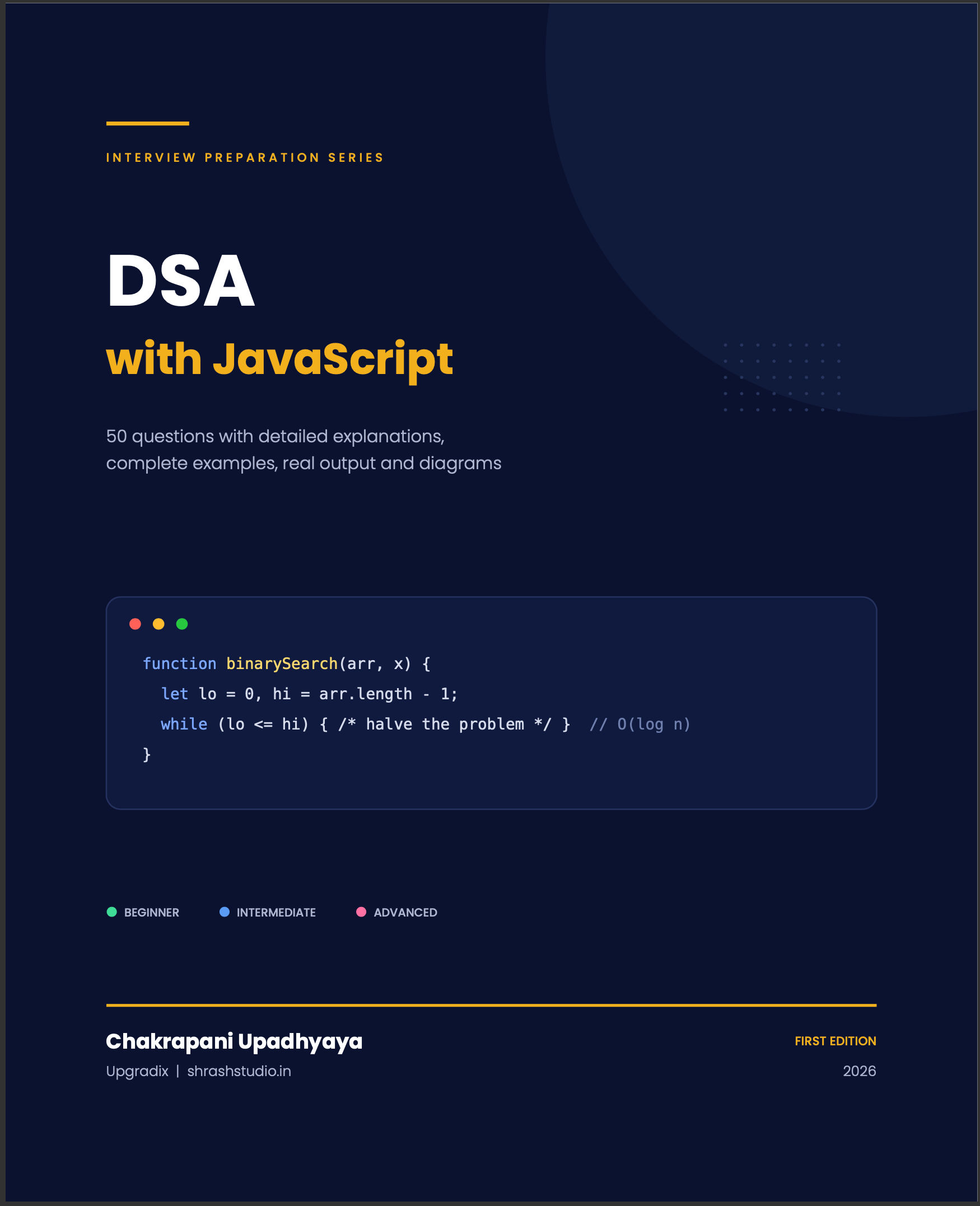
DSA with JavaScript: 50 Questions with Detailed Explanations
Master Data Structures and Algorithms with JavaScript through 50 carefully selected interview questions. Learn Big-O, arrays, hash maps, linked lists, stacks, queues, heaps, trees, graphs, searching, sorting, backtracking, dynamic programming, greedy algorithms and advanced DSA techniques with simple explanations, runnable code, real output, diagrams and interview-focused tips.
Free
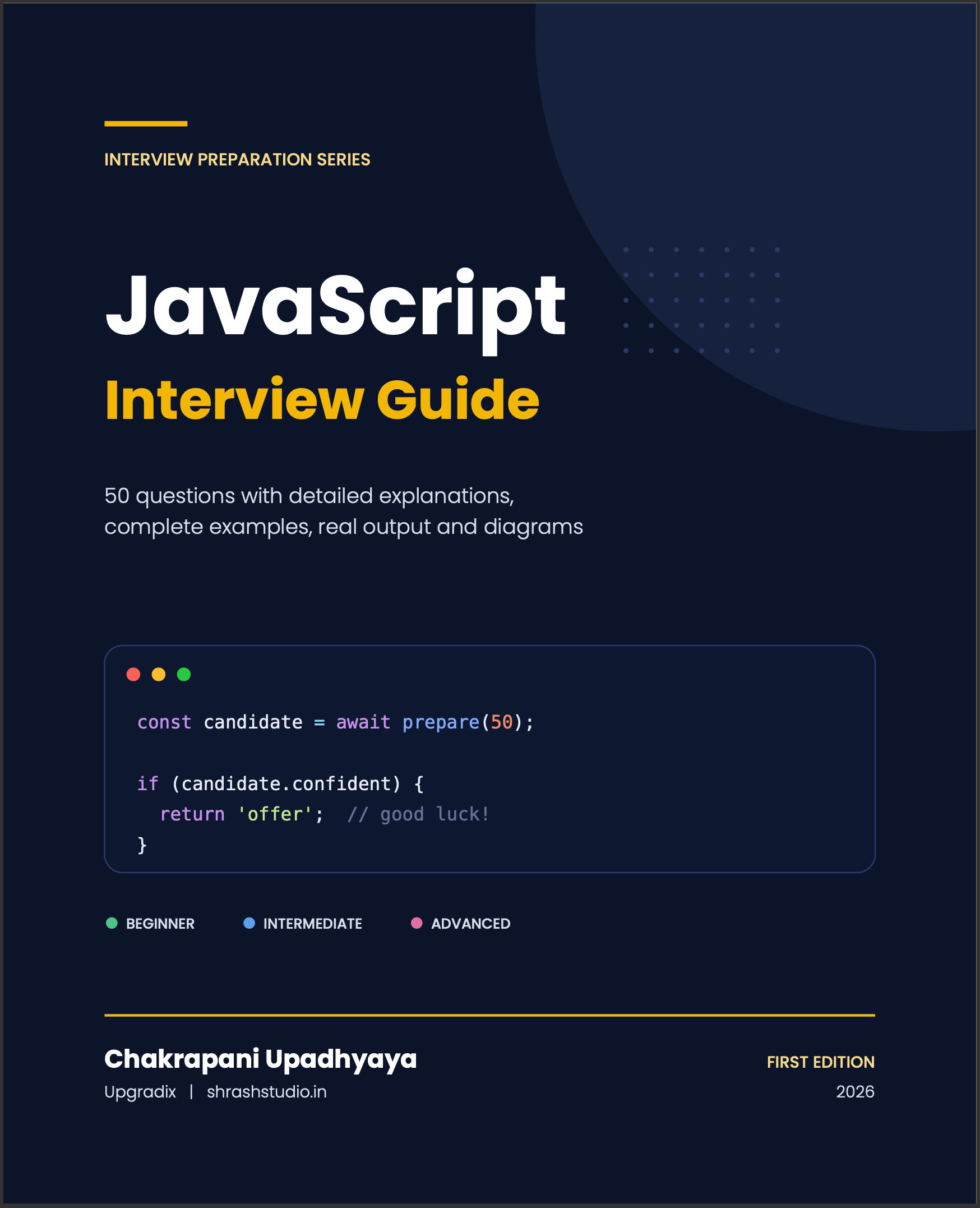
JavaScript Interview Guide — 50 Questions with Detailed Explanations
A practical JavaScript interview preparation guide covering 50 frequently asked questions with detailed explanations, complete runnable examples, real output, diagrams, interview tips and follow-up questions — from core language fundamentals to asynchronous JavaScript, browser APIs, performance and security.